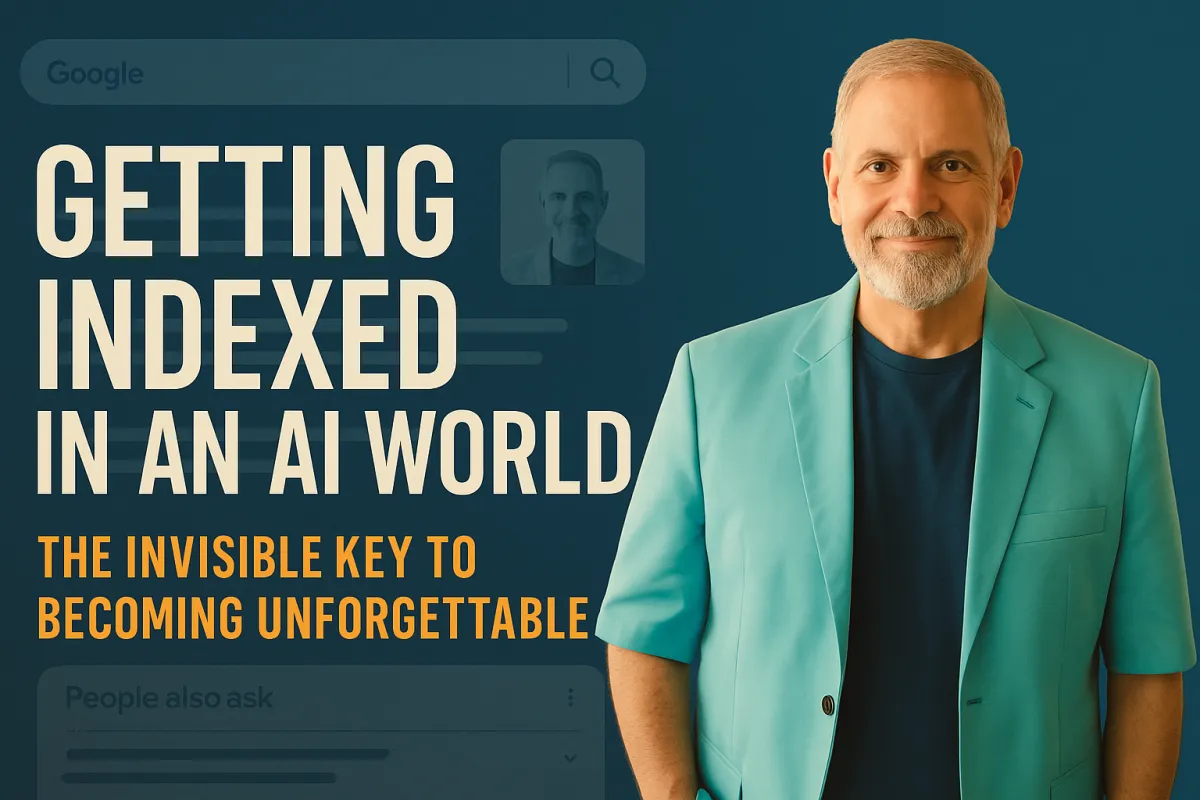
Getting Indexed in an AI World - The Invisible Key to Becoming Unforgettable
Before someone clicks your link, they must find you.
Before they find you, you must be indexed.
In a zero-click world, visibility isn’t just nice—it’s non-negotiable, especially if you want to achieve Megafluence for your personal brand.
“Megafluence isn’t just about being known—it’s about being trusted, searched for, and found everywhere that matters.”
— Eric Yaillen, Founder of Megafluence
You’ve probably heard the phrase “If a tree falls in a forest and no one hears it, does it make a sound?”
Let’s apply that to your personal brand:
If you publish amazing content but if the search engines such as Google don’t index it, do you really exist in the minds of your potential audience?
Welcome to the paradox of modern digital visibility.
You can be brilliant, insightful, generous with value… and still invisible—unless you’ve earned your place in the search engine’s mind.
The rise of AI and the dominance of zero-click search mean one thing: you no longer need people to visit your site to make a impression — Google and all the other major search engines do that for you.
But only if you play by its rules, and the most critical rule you must address is… Getting indexed.
In this article, we’ll unpack how indexing works, how to accelerate it, and how it fits into the larger framework of achieving Megafluence—a state of digital authority that transcends traffic, helps establish credibility and authority and fuels trust.
Why Indexing Is the Quiet Engine of Digital Authority
Visibility is the new currency of trust.
In a world where AI delivers answers directly in the search results — snippets, knowledge panels, and “People Also Ask” boxes, your ability to be indexed quickly and comprehensively is no longer a bonus.
This IS the bare minimum for authority.
“You can’t lead a market if Google doesn’t even know you exist.” — Eric Yaillen
The Zero-Click Paradigm Shift
Search has evolved from a portal into a destination.
Users increasingly get what they need without ever clicking through to your website by simply asking questions. This is the essence of what today is referred to as AEO (ask engine optimization) which has now supplanted SEO (search engine optimization)
Welcome to the Zero-Click Internet.
And while that might sound like a problem, it’s actually your greatest opportunity, but only if you’re positioned properly.
Your content can become the answer.
Your face can show up in the Knowledge Panel.
Your voice can be the quote AI reads aloud.
But to achieve ANY of this you first must be indexed.
How to Get Indexed (and Stay Indexed)
Let’s demystify the most overlooked step in search visibility: getting your content crawled and indexed by search engines.
1. Use URL-Pinging Services for Faster Crawling
The moment you publish content, your clock starts ticking. Search engines are busy—unless you tell them you’ve got something new. You can’t wait for them to find you, or you can skip the line and push your content to the top by using existing free services such as:
Pingomatic: Notifies a wide range of search engines of updated content.
IndexNow: A protocol supported by Bing and Yahoo that provides near-instant indexing.
Google Search Console: Submit new URLs directly for priority crawling.

These tools reduce the lag between publishing and appearing in search results. Think of them as VIP alerts to the bouncers at the velvet rope in front of each search engine’s front door.
2. Leverage CDNs for Global Speed and SEO Edge
Speed matters — for users and for bots. If you have slow page load times, you automatically are placed behind faster sites, so it behooves you to keep page sizes small, sleek and optimized.
A Content Delivery Network (CDN) stores copies of your site across the globe to ensure lightning-fast access.
Top options:
Cloudflare (we move the DNS [domain name servers] for all our clients to cloudflare as a strategy to help optimize and reduce page load times)
Akamai
Amazon CloudFront
CDNs improve page speed and also reduce bounce rates, which sends strong “quality signals” to search engines. Many also include built-in security and caching, keeping your content protected and always available for indexing.
3. Optimize Alt-Tags to Get Found in Image Search
Images tell stories. But only if Google understands them.
Alt-tags help search engines interpret what your images represent. For personal brands and thought leaders, this means your face, your brand visuals, and your infographics are searchable assets.
Every page that has images has the ability to add Alt-tags, but I am consistently amazed at how often these fields remain blank. It doesn’t matter whether or not the page was built by a solopreneur or a so-called pro at an agency. Far too many tend to put too much emphasis on what a page looks like than take a couple extra minutes to optimize how algorithms read the page.
Pro tips:
Use descriptive language, not just keywords.
Avoid stuffing. Be natural and helpful.
Add alt-tags to headshots, logos, and data visuals.
Remember: visually impaired users benefit from these too. So does your credibility.
Indexing Isn’t Just a Tactic—It’s a Trust Signal
“When your brand appears in a Featured Snippet or Knowledge Panel, you don’t need to shout anymore. You’ve already been endorsed by the algorithm.” — Eric Yaillen
At Megafluence, we believe influence without integrity is manipulation, and visibility without value is noise. True Megafluence is earned by showing up consistently where your audience searches—not by shouting louder, but by being trusted more.
Indexing is how you earn that trust. Not just with your audience—but with the invisible gatekeepers of attention: AI and search engines.
Play the Long Game: Visibility Over Virality
Zero-click content is not a quick win. It’s a long-game strategy that rewards consistency, quality, and infrastructure. It’s not about chasing pageviews. It’s about building a digital legacy.
When you’re consistently indexed, cited, and surfaced by AI and search tools, you stop being one of many—and start becoming the one they remember.
“Megafluence is built on moments of visibility that happen before someone ever lands on your website. That’s the power of zero-click influence.” — Eric Yaillen
Final Thoughts: What Indexed Content Really Does
It keeps your ideas in circulation 24/7.
It earns the trust of search engines and AI tools.
It helps you dominate your niche before a single click is made.
If you want to become a thought leader, it’s not enough to create content. You need to become discoverable—on Google, Bing, and beyond.
Getting indexed isn’t technical—it’s foundational.
Search Engine Indexing & Visibility FAQ
Q: What does it mean to be “indexed” by a search engine?
A: Indexing means your content has been discovered and stored in a search engine’s database, making it eligible to show up in search results.
Q: How long does it take for Google to index a page?
A: It can take anywhere from a few hours to several days. Using tools like Google Search Console and IndexNow can significantly reduce that time.
Q: What kind of content should I focus on getting indexed first?
A: Start with cornerstone content like About pages, service pages, blog articles, and anything designed to answer user intent clearly and helpfully.
Q: Do social media posts get indexed?
A: Yes—especially on platforms like LinkedIn and X (formerly Twitter). However, indexing is often more consistent with content on your own domain or high-authority sites.
Q: What’s the best way to see if my content is indexed?
A: Use the search operator: site:yourdomain.com/page-url in Google. If it shows up, it’s indexed.


